
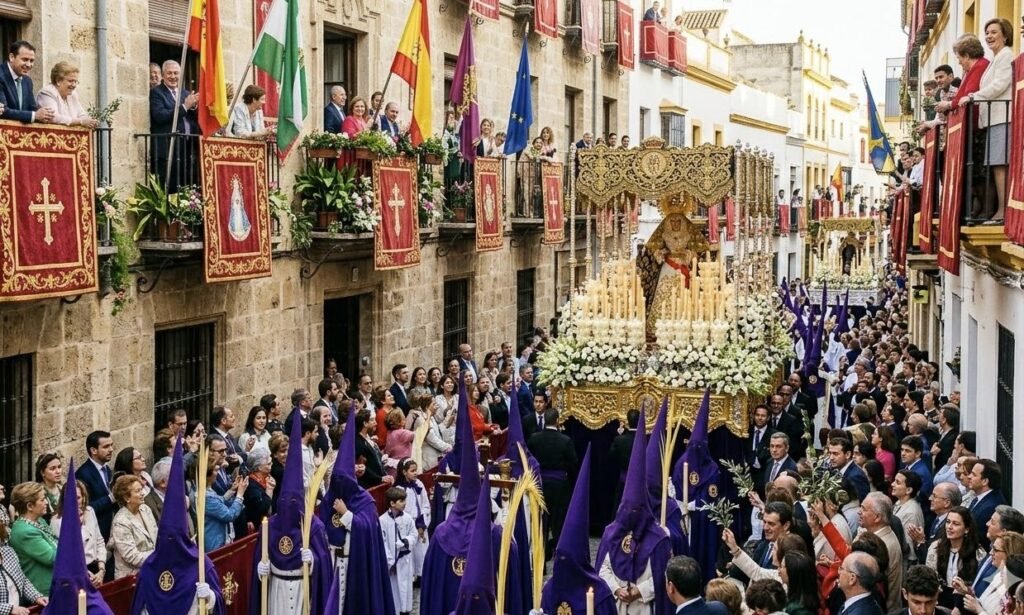
Easter in Spain is first and foremost Holy Week, Holy Week: seven days of street processions that are prepared in many cities all year round. Even if you are far from religion, this is one of the strongest traditions of the country, which is worth seeing at least once. We tell you what happens during these days, where the most interesting things are and what is put on the table.
When is Easter in 2027?
Spain celebrates Easter according to the Gregorian calendar, along with the entire Catholic world.
| Date | Day |
|---|---|
| March 21 | Domingo de Ramos – Palm Sunday, the beginning of Holy Week |
| March 25 | Jueves Santo – Holy Thursday |
| March 26 | Viernes Santo – Good Friday, a national holiday |
| March 28 | Domingo de Resurrección – Easter |
| March 29 | Lunes de Pascua – Easter Monday, a day off in some regions |
Orthodox Easter in 2027 falls on May 2, which is five weeks later. Many Ukrainian families in Spain celebrate twice: first they watch the processions, and then they set their table with Easter eggs and Easter eggs.
In which regions Thursday is a day off, and in which it is Monday, see weekend calendars for 2027.
What is Semana Santa?
Semana Santa lasts from Palm Sunday to Easter. Every day, processions take place through the streets, commemorating the last days of Christ's life: the entry into Jerusalem, the Last Supper, the trial, the crucifixion and the resurrection. The mood changes with the story: from the festive Palm Sunday to the silent, mournful night before Good Friday and the joyful Sunday morning.
The tradition dates back to the late Middle Ages, and took on its current form in the 16th and 17th centuries. At that time, many sculptures were created that are still carried today: in Valladolid or Seville, baroque museum pieces are literally carried through the streets.
Who's who in the procession
- Brotherhood, brotherhood – a lay brotherhood at a parish that organizes the procession. In large cities, there are dozens of them, and each can have thousands of members.
- Paso (in Malaga – throne) – a platform with a sculptural scene or figure of Christ or the Virgin Mary, decorated with flowers and candles. Weighs from several hundred kilograms to several tons.
- Costaleros – people who carry a platform on their shoulders or around their necks, often hiding under it. They move in short shifts following the commands of a senior (capataz).
- Nazarenes – participants in long tunics and pointed caps with their faces covered (capirote). The clothing signifies repentance and anonymity before God. The colors indicate which brotherhood a person belongs to. This costume has nothing to do with American racist organizations: it is several centuries older.
- Arrow – a short flamenco-style prayer song sung from a balcony as the platform stops below. Typical of Andalusia.
- Banda – a brass band with drums following the platform.
Where to watch
- Seville. The country's most famous Semana Santa: about sixty brotherhoods and processions from morning to night. The culmination is La Madruga, the night from Thursday to Friday.
- Malaga. Huge trono carried by hundreds of people, and the traditional participation of the Spanish Legion.
- Valladolid, Zamora, Leon. Castilian tradition: silence, austerity and sculptures of the highest artistic level.
- Cuenca. Processions through the narrow streets of the old town over the cliff and the drumming of the crowd (Las Turbas) on Friday at dawn.
- Cartagena and Lorca (Murcia). Bright, almost theatrical processions: in Lorca - with horses, chariots and silk-embroidered cloaks.
- Catalonia. The Passion (La Passió) is a popular outdoor performance, for example in Oles de Montserrat and Esparreguera, and the silent Dance of Death procession in Verges is a popular event here.
There are processions in almost every town and village. The schedule (itinerary) is published on the website of the city hall and local brotherhoods.
What do they eat at Easter?
On Good Friday, according to tradition, no meat is eaten, so the main foods of the week are salt cod, chickpeas, and sweet bread and dough.
- Torrijas. Slices of bread soaked in milk or wine, fried in egg, with sugar and cinnamon. Sold in every bakery from the beginning of Lent.
- Vigil potion. A thick soup made from chickpeas, spinach, and salted cod (bacalao).
- Cod fritters and other cod dishes: fried, with tomatoes, with potatoes.
- Easter Mona. Easter cake in Catalonia, Valencia and Murcia, once with a baked egg, now more often with chocolate figures. Godparents give it to godchildren on Easter Monday.
- Pestiños. Fried dough in honey, typical of Andalusia.
- Hornazo. A pie with meat, sausage, and egg in Salamanca and Ávila, eaten after the end of Lent.
- Fried milk, flowers, roscos. Regional fried sweets.
It is not customary to dye eggs here, as in Ukraine. Instead, children are given chocolate eggs and figurines.
How to behave at the procession
- This is a religious event. Do not cross the procession or speak loudly as the platform passes, especially in «processions of silence.».
- You can take pictures, but without the flash in the participants' faces.
- In Seville and Malaga, the best places along the official route are paid and sold out in advance. People watch for free on the side streets.
- Take comfortable shoes and water: you will have to stand for a long time, and the center is blocked.
- In the rain, processions are canceled because the sculptures are afraid of water. Check the forecast.
- For small children, it is better to choose daytime processions: night processions last until morning.
If you are planning a trip
Semana Santa is the peak season. Accommodation in Seville and Malaga increases in price several times and sells out months in advance, as do train tickets. Banks, institutions, and most shops are closed on Good Friday, and most regions are closed on Thursday, so do your shopping in advance.
The holidays don't end after Easter: in two weeks, Seville will begin April Fair – a week of flamenco, tents and horses. This is no longer a religious holiday, but a spring fair.
Interested in other Spanish holidays? Read about Three Kings Day and Christmas markets.

Comments
No comments yet — be the first!
Join the discussion
To leave a comment, log in — it takes a few seconds:
Sign in with Google Login / register